

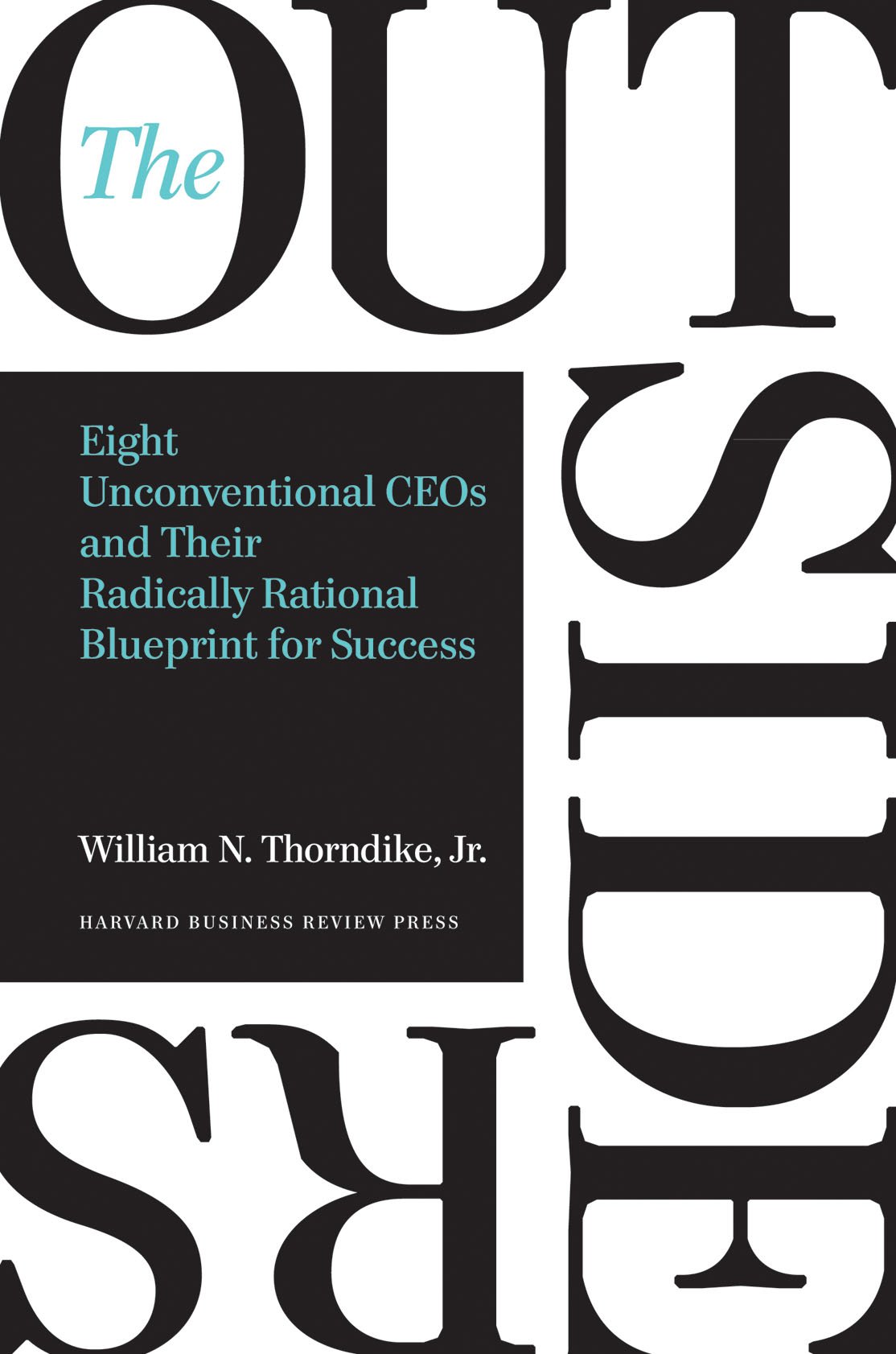
The Outsiders
William N. Thorndike Jr.
Summary
This book looks at the careers of 8 great CEOs throughout the 1900s who created more value for their shareholders than any other CEO. Businesses ultimately come down to the people who run them and these ones were the best over decades.
Rating: 3/5
Notes
CEOs are capital allocators and investors
Cash flow not earnings determines value
Independent thinking is essential to long term success
All had offices away from epicentres. Focus on small hubs
All had values like frugality, humility, independence and combo of conservatism/boldness
Key to longer term value creation is optimize cash flow, not earnings
‘The goal is not to have the largest train, but to arrive at the station with the least fuel’
Decentralization is the cornerstone. Let managers think for themselves
Look for talented younger foxes with fresh perspectives
Henry singleton and teledyne
- Share repurchases in large amounts when the stock is too low
Cash return on capital is the key metric
At their core, rational, pragmatic, agnostic and clear eyed
Most CEOs grade themselves on size/growth, but the important is shareholder returns
Malone and TCI (John malone)
- Ignored EPS and used pretax cash flow to grow and acquire subscribers
- He invented the term EBITDA
- Never paid significant taxes
- Bought and sold companies through stock instead of cash to avoid cap gains
‘Establishing and maintaining an unconventional approach requires frequently appearing imprudent in the eyes of conventional wisdom.’ - David Swanson
Stintz used cash for share repurchases or acquisitions
Smith (CEO of Cinemas) used cash earnings (net earnings + depreciation), not net income when evaluating a business
Buffet’s 3 approaches: cheap capital generation, capital allocation and management of operations
Portfolio mgmt: how many stocks an investor owns and how long he owns them
- High degree of concentration and extremely long holding periods
Always do the math, the denominator matters
Feisty independence/charisma is overrated
Crocodile-like temperament that mixes patience with occasional bold action
Long term perspective
Didn’t like dividends, disciplined and sometimes large transactions, used leverage selectively, bought back stock, minimized taxes, ran decentralized organizations and focused on cash flow over reported net income
Outsider checklist
- Allocation process should be CEO led
- Start by determining the hurdle rate - minimum acceptable return on investment
- Should be determined in reference to other opportunities and be in mid teens or higher
- Calculate returns for all internal and external investment alternatives and rank them by return/risk. Use conservative assumptions
- Projects with higher risk (acquisitions) should require higher returns
- Calculate return for stock repurchases. Require the acquisitions, returns meaningfully exceed this benchmark
- Focus on after tax returns and run transactions by tax counsel
- Determine acceptable, conservative cash and debt levels
- Consider deceentralized organization model
- Retain capital in the business only if you have confidence you can generate returns over time that are above the hurdle rate
- Consider a dividend but be careful (tax inefficient) if you don’t have high ROI projects
- When prices are high, consider selling a business or stock
***
Buy the book here
Free E-book download here
How the World Works
Noam Chomsky
Summary
A combination of books Chomsky wrote in the 80s and 90s about America and it's role in the world. Fascinating read and insight into one of the great thinkers of the 21st century
Rating: 5/5
Notes
The US invaded Greece in 1947 and supported a horrendous war which led to 160k Greek deaths. This was the model for Vietnam and allowed American business to gain and thrive
US policies in the 3rd world consistently opposed democracies if they couldn’t be controlled as real democracies believe government should respond to the needs of their own population rather than those of US investors
US-run contra forces in the 3rd world isn’t ordering killing - it’s brutal sadistic torture (Nicaragua, El Salvador, Guatemala)
From the Bolshevik revolution in 1917 till the collapse of the communist governments in eastern europe in the 80s, it was possible to justify every US attack as defense against the Soviets
If you want a global system that’s subordinated to the needs of US investors, you can’t let pieces of it wander off. It’s clearly stated in the documents of record
The US wants ‘stability’ meaning security for the upper classes and large foreign businesses
Solid case for impeaching every American president since World War 2 either outright as war criminals or involved in serious war crimes
El Salvador and Nicaragua were not covered by the US media in the 70s when US-supported brutal torture and murder were taking place
In the early 80s, America’s friends slaughtered 10s of thousands of Guatemalans with countless others tortured and raped
After Vietnam, the major US policy goal has been to maximize repression and suffering of countries demonstrated by their violence - blocked other countries from seeking aid
The US regularly carries out or supports aggression
For most of the 20th century, the US was the dominant economic power and used economic warfare as a weapon ranging from illegal embargoes to enforcement of weak IMF rules with their military becoming pre-eminent
The US tries to avoid negotiations with countries as the US fears it will lose and other countries will be better off
When a state has huge debts, it must divert the population from what’s happening and they do this by inspiring fear of our enemies (Russia in Europe)
The real enemy of the US has always been ‘the poor who seek to plunder the rich’. In America, it’s the opposite and has been for generations
‘The war on drugs’ was a manufactured media blitz by the US leadership to distract the population, increase repression in inner cities and build support for attack on civil liberties
The US government blocks international effort to seek peace (Russia and Ukraine)
Major media are large companies owned and interlinked with even larger conglomerates. The market is the advertisers and the product is audiences
The power in the US lies in the hands of people who determine investment decisions as they determine production, distribution and staff the government. They want a passive, quiescent population
The struggle of freedom is never over and requires active and sustained efforts
One important consequence of globalization is it extends the third world model to industrial nations where the average person has their jobs shipped away while the rich and elite continue to amass massive amounts of wealth
We’ve moved to an international state with the IMF, World Bank, G7 & EU, WEF where the general population doesn’t know what’s happening and it doesn’t know it doesn’t know
If the borrowing the US has done was used for constructive purposes like investment or infrastructure, the US would be better off, but it was used to enrich the rich - for consumption, financial manipulation and speculation which are all harmful
The class warfare of the last few decades has successfully weakened popular organizations leaving people to feel isolated
The US is so deeply in debt to the international financial community because of debt that they have a lock on US policy
Many of the large number of security council resolutions vetoed by the US have to do with Israeli aggression or atrocities
Invaders typically use local collaborators to run things for them by playing upon existing rivalries to get onne group to work for them against another
European wars were wars of extermination. If we were to be honest about history, we would simply describe it as barbarian invasion
There has always been racism but it developed as a leading principle of thought in the context of colonialism.
A standard technique of belief formation goes along with oppression
In the US, you’re not allowed to talk about the class differences, which is the real issue
When the US establishment talks about jobs, it means profits for its corporations
The elite are masters and they follow what Adam Smith said about ‘the vile maxim’ - all for ourselves and nothing for anyone else
People who aren’t owners and investors have nothing much to say in the US
Jefferson warned against banking institutions and corporations and said if they grow, aristocrats would’ve won and the revolution would’ve been lost
The ‘Free market’ is for the poor. We have a dual system - protection for the rich and market discipline for everyone else
There’s been a considerable increase in inequality and has the American society moving towards a third world model, thereby seeing increased crime and signs of social disintegration
A huge area of the media is dedicated to diverting people and making them more stupid and passive
There’s nothing individualistic about corporations who are totalitarian in nature
Free trade agreements result in reduced wages for local employees while predominantly benefiting the rich consumer while also destroying unions
Operation Paper Clip imported large number of known Nazi criminals
The American army’s counter-insurgency literature begins with an analysis of the German experience in Europe written with the co-operation of Naxi officials (instruments of statecraft - book)
US involvement in Chile with the coup in 1973 to reduce social democracy
The threat of a good empire is what the US worried about with reforms on uncontrolled capitalism
The US killed a few million people and destoryed 3 countries during the Vietnam war
A huge amount of business propaganda is to create wants
The answers to solve all these issues is to organize. Being alone you can’t do anything but if you join with other people, you can make changes
Under capitalism, investment is supposed to be as risk free as possible. No competition wants free markets - what they want is power
The government subsidizes corporations’ costs, protects them from market risks and lets them keep the profits
There’s never been much difference between the 2 business parties and the differences are disappearing
The CIA has been involved in drug running for generations (the politics of heroin book)
You need something to frighten people with, to prevent them from paying attention to what’s really happening to them. You have to engender fear and hatred
The first world lives in a highly indoctrinated society
Neoliberalism is nothing more than the imperial formula: free markets for you and plenty of protection for me. The rich would never accept it but they’re happy to impose it on the poor
The UN does mostly what US business wants
‘Politics is the shadow cast on society by big business’ - John Devery
If people dedicate themselves to organizing and activism, we’ll gain access to broader audiences
If you extrapolate to the future, it’s very ugly but the point is it’s not inevitable. It can be changed but we can’t change things till we understand them.
***
Buy the book here
Free E-book download here